
Blog
How Much Insurance Must a Trucking Company Carry? $750,000 to $5 Million
Federal rule 49 CFR 387.9 sets minimum coverage for motor carriers: $750,000 for for-hire interstate general freight, and $1 million or $5 million for hazardous loads. Here is what those numbers mean after a serious truck crash in North Carolina.
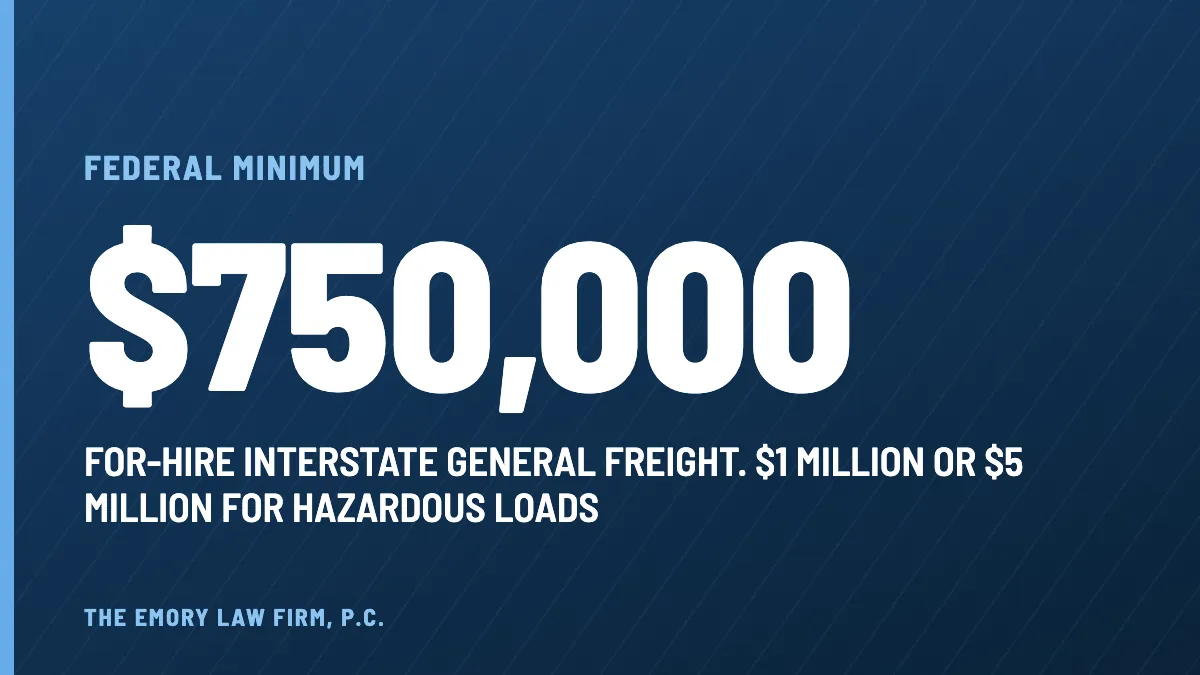
Quick answer: A trucking company’s minimum insurance depends on what it hauls. Under 49 CFR 387.9, a for-hire interstate carrier of non-hazardous freight in a vehicle rated at 10,001 pounds or more must have at least $750,000 of financial responsibility. Certain hazardous loads require $1,000,000 or $5,000,000. For someone badly hurt in a truck crash in North Carolina, these numbers matter because they tell you the kind of coverage that should exist.
They are floors. They don’t tell you what a claim is worth, and they don’t guarantee payment. This guide explains the rule in plain terms and what to do with it.
What does the federal rule require?
It sets minimum levels of financial responsibility for motor carriers, based on the type of carriage and the commodity on the truck. The table in section 387.9 has four rows, and the amount depends on three things: who the carrier is, where it operates, and what it is hauling. The rule covers public liability, meaning harm to others.
How much coverage applies to which load?
Here is the federal schedule in plain language. The exact commodity definitions are in the rule itself, so treat this as a guide to what to ask.
| Who and where | What is hauled | Minimum |
|---|---|---|
| For-hire, interstate or foreign, 10,001 pounds or more | Non-hazardous property | $750,000 |
| For-hire and private, interstate, foreign or intrastate, 10,001 pounds or more | Certain hazardous substances in bulk, and certain other dangerous materials | $5,000,000 |
| For-hire and private, interstate or foreign in any quantity, or intrastate in bulk only, 10,001 pounds or more | Oil, hazardous waste, and other hazardous materials not in the $5,000,000 rows | $1,000,000 |
| For-hire and private, interstate or foreign, under 10,001 pounds | Certain materials in bulk, and highway route controlled quantities of Class 7 material | $5,000,000 |
Does the $750,000 minimum apply to every truck?
No. That row covers for-hire carriers in interstate or foreign commerce hauling non-hazardous property. A company carrying its own non-hazardous goods is not in that row, and a truck that stays inside North Carolina is not in it either. So one of the first questions in a truck case is what the truck was doing that day and for whom.
So write down the company name on the door, any USDOT number and what the truck was carrying, if you can tell. The other details come from the records the carrier holds.
Why does the minimum matter in a serious injury case?
Because serious injuries run into serious money, and a personal auto policy is built differently. The Department of Insurance explains that a personal policy has limits per person and per accident, and uses 100/300/50 as an example: up to $100,000 for one injured person and $300,000 for all injured people in a single accident.
That is an example, not a rule, and your case may involve other coverage. But the comparison shows why it is worth finding out what the trucking company’s policy says. The department also notes that bodily injury claims can include doctor and hospital bills, laboratory fees, lost wages and pain and suffering, with no statutory formula for pain and suffering.
How can you find out what coverage a carrier has?
Start with the proof the rule requires. Section 387.7 says proof of financial responsibility must be kept at the carrier’s principal place of business. It consists of an MCS-90 endorsement issued by an insurer, an MCS-82 surety bond, or a written federal authorization to self-insure.
The rule also says this proof “shall be considered public information and be produced for review upon reasonable request by a member of the public.” A lawyer can ask for it, along with any other policies that may apply.
What should you not assume about insurance?
Three things. Don’t assume the minimum is all there is, because it is only the floor. Don’t assume the money is automatic either, because coverage does not settle who was at fault. In North Carolina, one finding of fault can bar a claim. And don’t assume you have plenty of time. You generally have three years to file for a personal injury, and two for a wrongful death.
What else matters besides the coverage?
What caused the crash. Coverage is only one part of a truck case. The same body of federal rules covers how long a driver may drive and how carriers must maintain their trucks, and the carrier’s records can show whether those rules were followed.
Why call The Emory Law Firm about a truck claim?
Randy Emory has seen insurance from the inside. He spent three years in State Farm’s claims department after law school and has handled over 16,000 auto claims during his career. He started The Emory Law Firm in Charlotte in 2001. Read more about Randy.
No background predicts the result of a case. But if you were seriously hurt, or you lost someone, you should know what coverage may be there before you talk numbers with anyone. Talk to the firm at (704) 371-4333. The firm is bilingual, in English and Spanish.
Sources
This article is general information about North Carolina and federal law, not legal advice. Every case is different, so talk to a lawyer about yours. Reading it or contacting the firm does not create an attorney-client relationship.
FAQ
Common Questions
Still have questions? Call (704) 371-4333, Monday to Thursday 9am to 5pm and Friday 9am to 4pm.
What is the minimum insurance for a semi-truck hauling general freight?
For a for-hire carrier in interstate or foreign commerce, with a vehicle rated at 10,001 pounds or more, hauling non-hazardous property, the minimum under 49 CFR 387.9 is $750,000.
Is the federal minimum the most an injured person can recover?
No. It is a minimum level of financial responsibility, not a cap on damages and not a promise of payment. A carrier may have more coverage, and what a claim is worth depends on its facts and on North Carolina law.
Can I find out what coverage a trucking company has?
The federal rule says proof of the required minimum, kept at the carrier's principal place of business, is public information that must be produced for review on reasonable request by a member of the public. That proof is usually Form MCS-90 or MCS-82.
More articles
-
Brakes, Tires and Upkeep: What Truck Carriers Must Inspect and How Long They Keep the Records
Federal rules make every motor carrier systematically inspect, repair and maintain its trucks, and keep the records for 1 year and for 6 months after a truck leaves its control. Here is what those rules cover and why they matter after a serious crash in North Carolina.
Read more -
Drug and Alcohol Tests After a Truck Crash: The 8-Hour and 32-Hour Windows
After a fatal truck crash, or an injury or tow-away crash with a citation, the trucking company must test its driver. Alcohol testing stops at 8 hours and drug testing at 32 hours. Here is how 49 CFR 382.303 works and why the timing matters.
Read more -
Hit by a Truck in North Carolina: Why One Finding of Fault Can End Your Claim
North Carolina's contributory negligence law can bar a driver found partly at fault from collecting damages. Here is what that means after a serious truck crash, and what to do before you talk to the trucking company's insurer.
Read more
Get In Touch
Ready to Get Started?
If this sounds like your situation, we can help.