
Blog
Drug and Alcohol Tests After a Truck Crash: The 8-Hour and 32-Hour Windows
After a fatal truck crash, or an injury or tow-away crash with a citation, the trucking company must test its driver. Alcohol testing stops at 8 hours and drug testing at 32 hours. Here is how 49 CFR 382.303 works and why the timing matters.
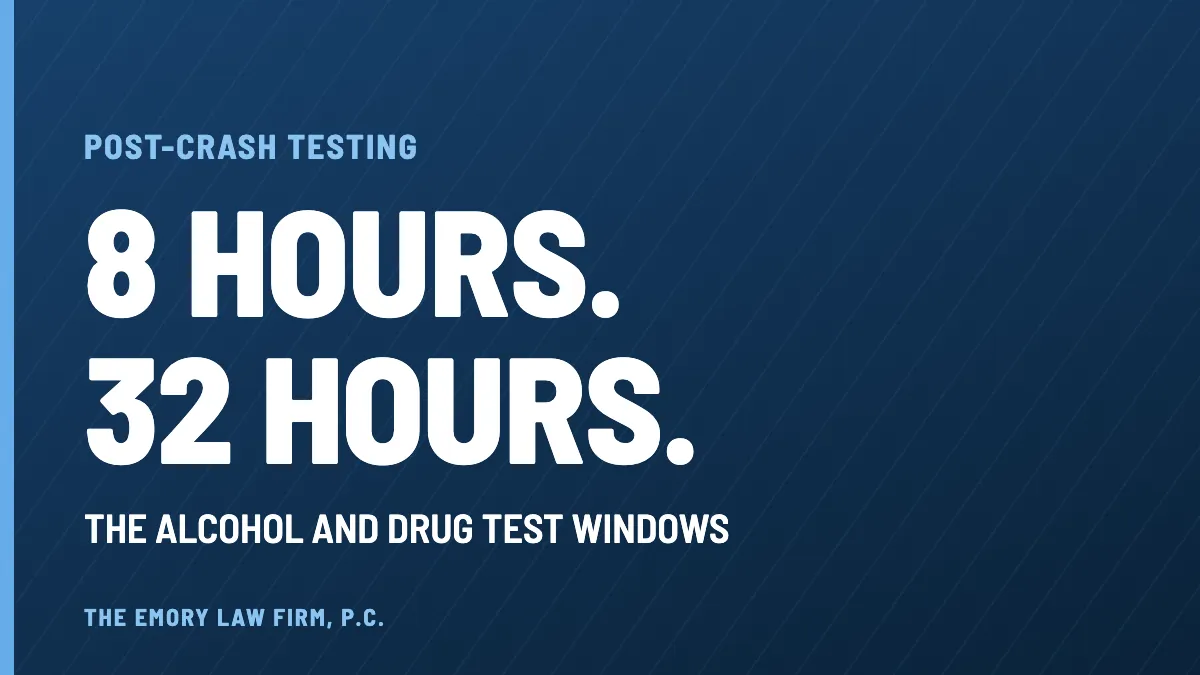
Quick answer: After certain truck crashes, federal rule 49 CFR 382.303 requires the trucking company to test its driver for alcohol and drugs as soon as practicable. Any crash with a death triggers both tests. A crash with an injury treated away from the scene, or a vehicle towed, triggers them if the driver gets a citation in time: within 8 hours for alcohol, within 32 hours for drugs. Alcohol testing stops at 8 hours and drug testing at 32 hours.
After a serious truck crash in North Carolina, those tests, or a missing test, can tell you a lot. Here is who must be tested, when, and what records the carrier has to keep.
Which truck drivers do these testing rules cover?
Generally, people who drive a commercial motor vehicle and are subject to the commercial driver’s license rules, along with their employers. The duty sits on the employer: section 382.303 says “each employer shall test” for each of its surviving drivers. It applies to an occurrence involving a commercial motor vehicle operating on a public road in commerce.
What kind of crash triggers a test?
Three kinds. It depends on the harm and on whether the driver was cited. A death requires a test whether or not there was a citation. An injury or a tow-away requires a test only if there was a citation. The federal rule includes this table, restated here:
| Type of crash | Driver cited? | Must the employer test? |
|---|---|---|
| A death | Yes or no | Yes |
| Injury with immediate medical treatment away from the scene | Yes | Yes |
| Injury with immediate medical treatment away from the scene | No | No |
| A vehicle with disabling damage, towed from the scene | Yes | Yes |
| A vehicle with disabling damage, towed from the scene | No | No |
Under the rule, the citation has to be for a moving traffic violation arising from the crash, under state or local law. It has to come within 8 hours for the alcohol test and within 32 hours for the drug test.
How do the 8-hour and 32-hour windows work?
Both tests must happen as soon as practicable. For alcohol, if a test has not been given within 2 hours, the employer must prepare and keep a record stating why. At 8 hours the employer stops trying and keeps the same record. For drugs, the employer stops trying at 32 hours and records the reasons.
Why does the timing matter so much?
Because a test that never happens can’t answer the question. Once a window closes, the rule tells the employer to stop trying. What is left is the record of why the test was not given, and that record should be requested. Records must be submitted to FMCSA on request, so they should exist.
The rule also says a driver subject to testing must stay readily available or may be deemed to have refused. It does not require delaying necessary medical care, and it allows a driver to leave the scene to get help or emergency care.
Can a police test count instead?
Yes, in some cases. The rule says a breath or blood alcohol test, or a urine drug test, done by federal, state or local law enforcement with independent authority meets the requirement, as long as it follows the applicable testing rules and the employer obtains the results. So the first place to look may be the police file, as well as the carrier’s.
Are there exceptions?
A few. The section does not apply to an occurrence involving only boarding or alighting from a stationary vehicle, only loading or unloading cargo, or the operation of a passenger car or multipurpose vehicle by an employer unless it is carrying passengers for hire or placarded hazardous materials.
How long does the carrier keep test records?
Between one and five years, depending on the record. Section 382.401 says alcohol results of 0.02 or greater, verified positive drug results, and refusals to test are kept for at least five years. Records of the collection process are kept for at least two years. Negative drug results and alcohol results under 0.02 are kept for at least one year.
Those periods are longer than for driver logs or driver inspection reports, which is another reason to request everything at once rather than one record at a time.
What does a test result mean for your claim?
It is one piece of the case. A positive test can help explain a crash. A clean test, or none, does not end the question of who caused it, and the fault fight still matters in North Carolina, where one finding of fault can bar your claim. The same goes for what coverage the carrier has.
Why call The Emory Law Firm about a truck crash?
Randy Emory worked in State Farm’s claims department for three years after law school, and he started The Emory Law Firm in Charlotte in 2001. See the firm’s truck accident page for how a truck claim differs from a car claim, or read more about Randy.
If you were seriously hurt, or you lost someone, in a crash with a commercial truck, talk to the firm at (704) 371-4333. The firm is bilingual, in English and Spanish.
Sources
This article is general information about North Carolina and federal law, not legal advice. Every case is different, so talk to a lawyer about yours. Reading it or contacting the firm does not create an attorney-client relationship.
FAQ
Common Questions
Still have questions? Call (704) 371-4333, Monday to Thursday 9am to 5pm and Friday 9am to 4pm.
When does a trucking company have to drug test its driver after a crash?
Under 49 CFR 382.303, whenever the crash involved a death. Also when the driver is cited for a moving violation within 32 hours and someone got immediate medical treatment away from the scene, or a vehicle had disabling damage and was towed.
How long does the company have to run the tests?
The tests must happen as soon as practicable. If an alcohol test has not been given within 2 hours, the employer must record why, and it stops trying at 8 hours. A drug test stops at 32 hours. In both cases the employer must keep a record of the reasons.
How long are the test results kept?
Under 49 CFR 382.401, alcohol results of 0.02 or greater, verified positive drug results and refusals are kept for at least five years. Negative drug results and alcohol results under 0.02 are kept for at least one year.
More articles
-
Brakes, Tires and Upkeep: What Truck Carriers Must Inspect and How Long They Keep the Records
Federal rules make every motor carrier systematically inspect, repair and maintain its trucks, and keep the records for 1 year and for 6 months after a truck leaves its control. Here is what those rules cover and why they matter after a serious crash in North Carolina.
Read more -
Hit by a Truck in North Carolina: Why One Finding of Fault Can End Your Claim
North Carolina's contributory negligence law can bar a driver found partly at fault from collecting damages. Here is what that means after a serious truck crash, and what to do before you talk to the trucking company's insurer.
Read more -
How Long Do You Have After a Serious Truck Crash in North Carolina?
North Carolina generally gives you three years to file a personal injury lawsuit under G.S. 1-52(16) and two years for a wrongful death under G.S. 1-53(4). Here is when those clocks start, and why the trucking company's records can't wait that long.
Read more
Get In Touch
Ready to Get Started?
If this sounds like your situation, we can help.